TRAVEL DIARY #3: CHINA
When I grew up in China, I was lucky to be in a city buzzing with cosmopolitanism, where skyscrapers jutted like teeth, and a humming sense of energy/urgency draped people in arrogance; ecstasy; exhaustion. For some, China may be a question mark stitched of too many people, embellished with the same cheap, artificial stuff it seems to pump out at a stupefying rate. But having been born and grown up there, I have some stereotypes to challenge. My recent trip back to China, I hope, will help dispel some of them.
First, I visited my home province, Guizhou. If you translate the name of the province, it means "expensive/precious province" (Gui can mean both expensive and precious). I tend to think of it as priceless and invaluable. My maternal grandmother lives in Guiyang, the province capital; we went there for a few days. The first thing we did when we got off the plane (15-hour flight...sleep, homework, sleep, repeat) was go eat 牛肉粉, or beef rice noodles.
BEEF NOODLES.
If you haven't tasted it yourself, you probably wouldn't understand the fanaticism. Let's just say: it's probably my favorite food in the world. In Guizhou, we engulf spicy stuff the way Americans love their Starbucks: Unapologetically. I craved this stuff the way Romeo longed for Juliet, Paris for Helen, John for Sherlock-
Is that too far?
Anyways, China is full of delicacies that vary sometimes even just from city to city. Another Guizhou favorite of mine is 肠旺面, which translates to Pork Intestine Noodles. I don't know if that sounds weird to a Western audience...
Told you we love our spicy stuff. This bowl of noodles is so good, I might have just drooled looking at the picture. In addition to pork intestine, there's pig blood and 脆哨 in the bowl, which I don't really know how to translate, except that it's this little cube of crispy, crunchy meat, and if you eat it, it might just become your new favorite addiction. At this moment, I'd like to apologize to the vegetarian/vegan readers of this blog. I try to eat vegetables-only meals as often as I can (keyword: try), but when I haven't been back in so long and China taunts me with all these favorites from my childhood... how can I resist?
Segueing from food--I noticed this beautiful truth as I wondered about the city. It is steeped in tradition, yes, in the architectural details and the slogans of restaurants, but it was, more incredibly, a city slumbering and waking in the embraces of mountains. It nestles between summits and hills, rivers and pagodas, so that sometimes the apartments or hospitals look like the brick armor of a mountain beast, crimson-black beneath the magic of crescent moons.
I know people always say that China is so polluted, it's revolting... But I wish they'd see that China is not only Beijing, Shanghai, or Hong Kong, international cities whose images have been fleeced by Western media, whose bones of history and culture remain a myth, an exotic hyperbole, an alien mystery. Because--and not to dismiss the environmental problems, which do exasperatingly exist and persist--if you look around, there is nature everywhere. On the tops of apartments; flanking bridges...
Nowhere do you see more greenery than in the countryside, though. My paternal grandparents are still farmers, and their home hugs the heart of the mountain valleys, where roads are too narrow/pebbled for cars. I walked with my cousins between rice paddies, jumping from crumbling soil, across skittering rivers, shoes smeared with mud and scat.
 |
| A panorama of the village, featuring my maternal grandmother |
 |
| A close-up of a house in the village |
On our way back home from the hike, we ran into some humans
and a horse.
We arrived to find steaming food and delicacies usually saved for New Year celebrations. It's rare for our entire extended family to get together like this. Sometimes I think about how I am in such a different world from them, but then my cousin plays the newest Taylor Swift song on her phone, and I grin, because what is 8000 miles when we are family, when worlds can shrink to pixels on a screen?
Country food tastes different, infused with this richness that only plants and vegetables that thrived free from chemicals can boast.
 |
| One of my relatives cooking |
 |
| My great-aunt sitting by the furnace, tossing in fuel to satiate the flames |
 |
| The house had few windows, draping the scenery in chiaroscuro |
Then it was time for a family excursion. We went to visit a mountain/park famous for its monkeys.
They were mesmerizing. Baby monkeys grabbed onto their mothers, and many times tourists threw away food to avoid the taunting blow of a rapaciously hungry monkey.
Of course, I worry about the safety and health of these animals. The yogurt, popcorn, chocolate can't possibly be good for them. But there are many people selling peanuts and sometimes, bananas, for tourists to feed monkeys with, and I can also understand the tourists' eagerness to part with their snacks when a monkey menacingly marches up to them.
My favorite part of my trip, though, is absolutely my time spent teaching and interacting with some sixth grade students in a village close to my home village. Curiosity rimmed their incessant questions, and a bravery I still don't feel glowed in them, so that they danced, and sang, and cried without regret or self-consciousness.
 |
| Me with some of the kids and the principal |
It's funny, actually, because the two boys in the picture above didn't show up half the time because they were helping their parents do laundry or cook, yet the boy in the white shirt ended up winning a mini-contest I threw. Just goes to show that full attention part of the time can be more valuable than paying only part attention the full time.
Their village was incredible as well. Emerald rivers, mountains sky-high; bamboo forests stunted beneath a gaping sky, telephone lines slicing through leaf-dusted paths as if plucked from another world. ..
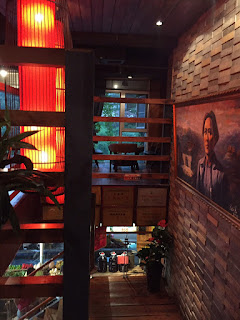

Guizhou still did not fail to impress me. As is typical in China, many restaurants and apartments flaunted details reminiscent of ancient architecture.
The rain was unmerciful, but a miraculous sight to this California girl.
MORE amazing food:
 |
| I had to snap this picture before anyone got in it... the restaurant crowds, man. Crazy. But not unexpected. |
 |
| MY ABSOLUTE FAVORITE DESSERT. Fruit roti prata.Yes, Indian food in China. |
For the last two and a half days of my trip, we flew to Guangzhou, the capital of the province where I went to school, Guangdong. Guangzhou was the international city that Guizhou didn't yet dare be, but in its own hustle, it bloomed a city of beauty.
In China, the public transport system is life. Frankly, I wish more people rode trains, buses, and subways in the U.S. Especially in commercial cities such as Guangzhou, the subway stations were plump with people and underground shops.
Guangzhou also boasts impeccable seafood. I am not a big fan of seafood (at all), but even I was sold.
 |
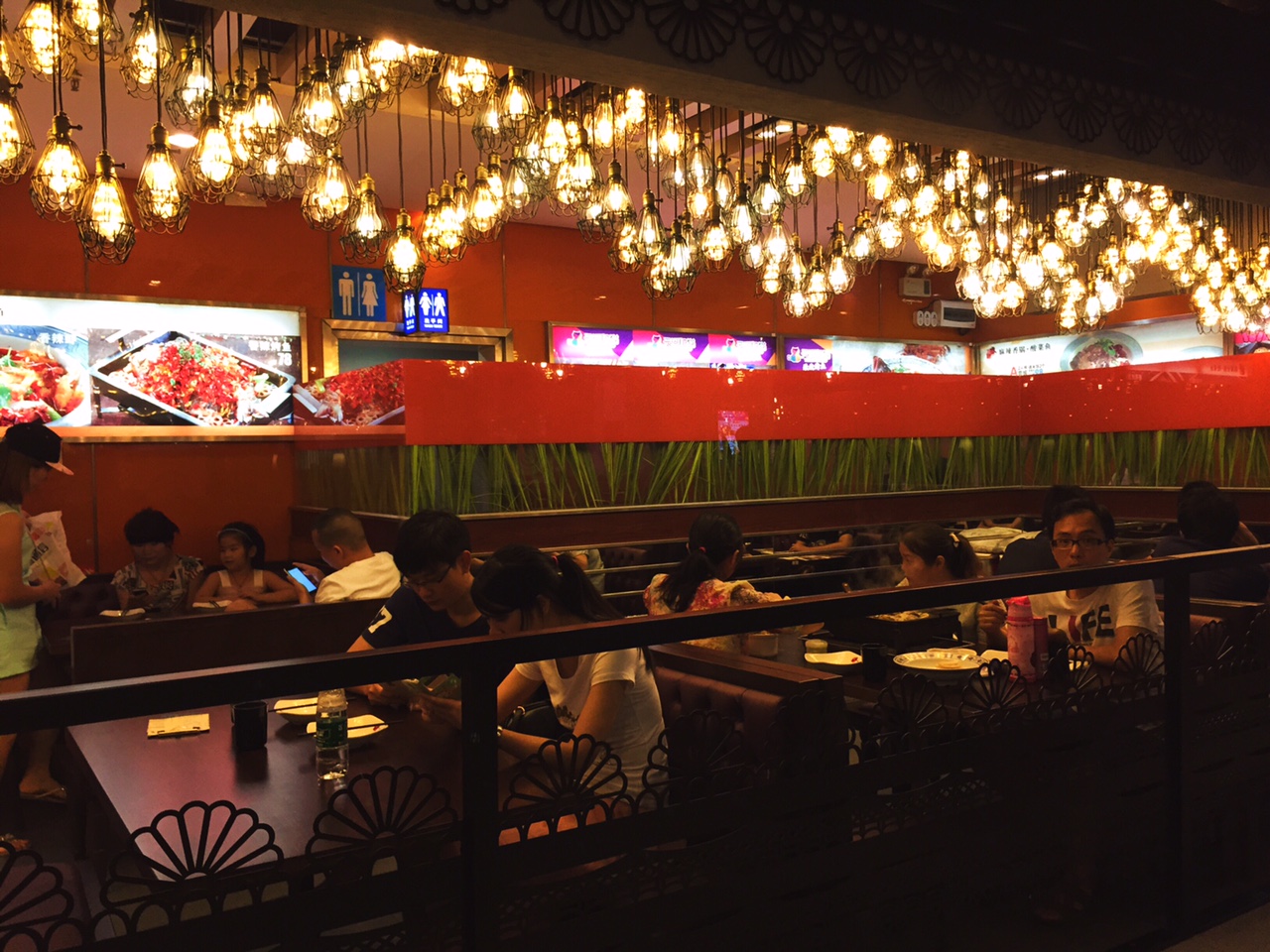
| Restaurant in a 20-story mall |
In the end, though, the most meaningful part of my journey in Guangzhou was... yes, shopping. I rarely shop, both because of money and because I rarely find clothes that fit my peculiar tastes. But in Guangzhou I stumbled across shops in markets as blurred/fleeting as staccatos, where shopping through the windows of buses and taxis inevitably ended with my feet almost hypnotically rushing to a specific dress. I told myself that since I barely ever buy anything that I will give myself this opportunity to buy whatever I want.
So I did, haha. I'll do another post on the clothes I bought in China next week.
Ah... There was something so... alive about Guangzhou. I felt like pirouetting, like falling dizzily onto clumsily-made beds and rushing out into sun-dusted rain, tripping over myself to soak in the hustle that floods the blood of this city. Somehow it blended together a smearing sense of nostalgia with a culture inked in history and commonality, so that even footsteps sunk into its fabric. The sky may be pollution-stained, but it also drooped like an eyelid, half-awake, half-entranced, just like the city--just like me.
That is, in the end, what I love most about China. It is a juxtaposition of dynasties and ghost-like democracies. Of brutality and honesty, beauty and busy-living. Of rugged mountainsides and vertical cities, where towers hunch over a billion people like sentries to a giant's city.
And, most importantly, it's home. It's my family.